How Much Should I Feed My Puppy?
Puppy feeding depends on age, expected adult size, and the specific food's calorie density — here's how to figure it out.
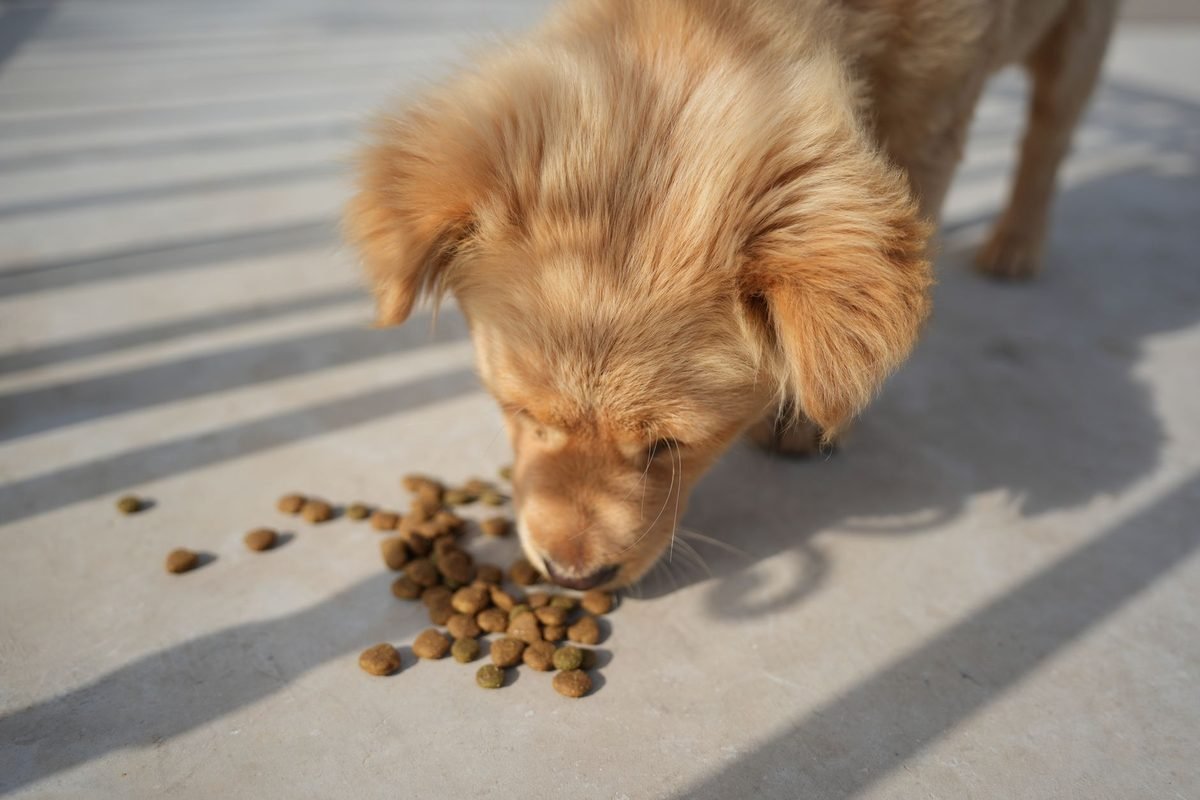
Enter your puppy's weight and life stage to estimate exactly how much to feed per day.
Calculate My Puppy's Calories →Start with the food label
Every puppy food is different. The bag or can should have a feeding guide based on your puppy's current weight and age — start there, then adjust based on body condition (you should be able to feel, but not see, the ribs).
How often to feed by age
- 6–12 weeks: 4 meals a day.
- 3–6 months: 3 meals a day.
- 6–12 months: 2 meals a day.
- Adult (after 12 months, later for large/giant breeds): 1–2 meals a day.
Large and giant breed puppies need extra care
Overfeeding large and giant breed puppies can cause them to grow too fast, which raises the risk of joint problems later in life. Use a large-breed puppy formula if you have one of these breeds, and don't free-feed (leave food out all day).
Estimate your puppy's calorie needs
For a rough daily calorie target based on current weight and life stage, use the Dog Calorie Calculator — puppies under 4 months need roughly 3x their resting energy needs, tapering to about 2x from 4 months until they reach adult size.
Curious how big your puppy will get? Try the Puppy Weight Calculator to estimate their adult weight from their current weight and age.
Signs you're feeding too much or too little
- Too much: rapid weight gain, no visible waist from above, ribs hard to feel.
- Too little: ribs, spine, or hip bones very visible, low energy, poor coat condition.
Every puppy's metabolism is different — check in with your vet at routine visits to track growth and adjust feeding as needed.
Body condition beats any chart
Feeding guides on packaging are population averages, and individual puppies vary substantially in metabolism and activity. The reliable method is to assess your puppy's body condition every week or two and adjust.
What you are looking for:
- Ribs: easily felt with light pressure, but not visible at a glance.
- From above: a visible waist behind the ribs.
- From the side: an upward tuck from the ribcage to the hind legs.
If you have to press to find ribs, reduce the portion by about 10 percent and reassess in two weeks. If the ribs, spine, and hip bones are clearly visible, increase by a similar amount. Vets use a nine-point body condition score for this, and asking your vet to show you the assessment once is worth more than reading about it.
Why overfeeding large-breed puppies is a specific risk
This is the most consequential point in puppy feeding, and it is widely misunderstood. Overfeeding a large or giant breed puppy does not merely cause weight gain; it accelerates skeletal growth beyond what the developing joints can support, and is associated with developmental orthopedic disease including hip and elbow dysplasia and osteochondrosis.
Excess dietary calcium is a particular concern, because large-breed puppies cannot regulate calcium absorption as efficiently as adults. This is why large-breed puppy formulas exist: they are calorie- and calcium-controlled specifically to slow growth to a safer rate.
The counterintuitive takeaway is that a lean, slower-growing large-breed puppy has better long-term joint outcomes than a rapidly growing one. Do not supplement calcium unless your vet has specifically directed it, and do not free-feed.
Reading the label properly
Two things to check on any puppy food:
First, the AAFCO statement. Look for wording confirming the food is complete and balanced for growth, or for all life stages. For a large-breed puppy, look specifically for the phrase including growth of large size dogs, typically defined as 70 pounds or more as an adult. A food formulated only for adult maintenance is not appropriate for a growing puppy.
Second, remember that feeding guides on the bag are based on expected adult weight, not current weight, for most puppy foods. Feeding to current weight is a common and significant error.
Transitioning food safely
Sudden diet changes cause diarrhea in puppies reliably. Transition over seven to ten days: roughly 25 percent new food for the first few days, then half and half, then 75 percent, then complete. If loose stools appear, slow down rather than pushing through.
When you bring a puppy home, keep them on whatever the breeder or shelter was feeding for the first week regardless of your plans. Moving house is enough of a change on its own.
Treats, and the 10 percent rule
Treats should stay under about 10 percent of daily calories, and this matters more during training than at any other time, since a puppy in a training phase can earn a great deal of food. Subtract training treats from the daily meal allowance rather than adding them on top. Using part of the puppy's measured daily kibble as training rewards sidesteps the problem entirely.
When to switch to adult food
Timing depends on adult size, because larger breeds grow for longer:
- Toy and small breeds: around 9–12 months
- Medium breeds: around 12 months
- Large breeds: around 12–18 months
- Giant breeds: around 18–24 months
Switching a large-breed puppy to adult food too early cuts calories during a period of continued growth; switching too late oversupplies calories once growth has stopped.
When to call your vet
Contact your vet if your puppy is losing weight, not gaining over a two-week stretch, has persistent diarrhea or vomiting, has a distended abdomen, or seems lethargic. Puppies have limited reserves and deteriorate faster than adult dogs, so a puppy that stops eating for more than about 12 hours warrants a call rather than a wait.
Common questions
Should I feed my puppy based on current weight or adult weight?
Most puppy food feeding guides are based on expected adult weight, not current weight. Feeding to current weight is a common error that leads to underfeeding. Check the specific chart on your bag, then adjust based on body condition.
Can I overfeed a large-breed puppy?
Yes, and it carries a specific risk beyond weight gain. Overfeeding accelerates skeletal growth past what developing joints can support and is associated with hip and elbow dysplasia. Use a large-breed puppy formula, do not free-feed, and do not supplement calcium unless your vet directs it.
When should I switch my puppy to adult food?
It depends on adult size: roughly 9 to 12 months for small breeds, 12 months for medium, 12 to 18 months for large, and 18 to 24 months for giant breeds. Larger dogs grow for longer and need puppy formula for longer.